
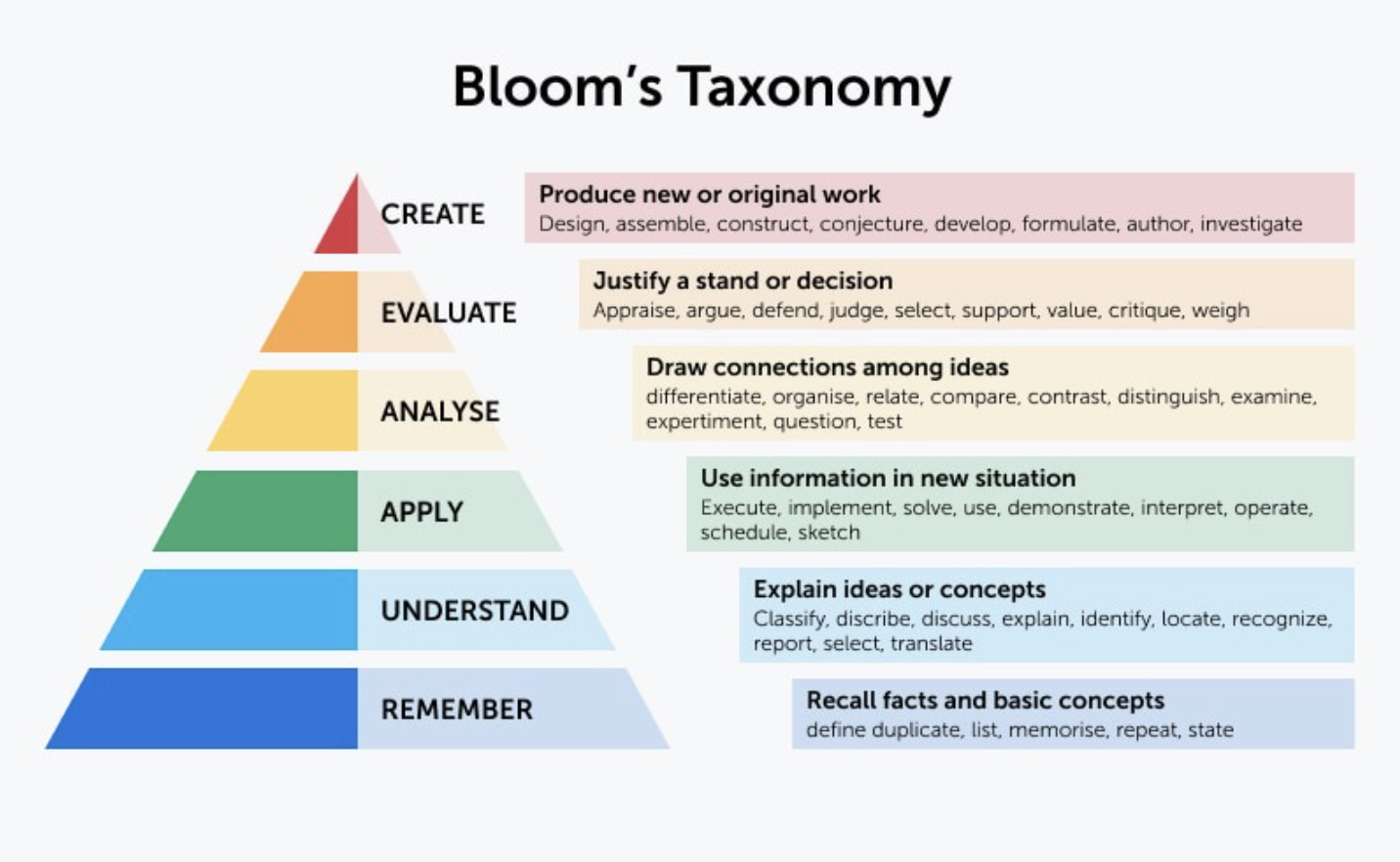
The expectation is straightforward, though not easy: aim for the top of Bloom’s and the right of ICAP’s during coach-facilitated sessions:
- Ideally any new information that we want participants to remember or understand will be provided in at least two ways (writing or audio or video) in addition to coach-facilitated sessions
- Often the first half of any coach-facilitated session will be used to have participants apply current ideas and draw connections among current ideas
- Ideally at least the second half of each coach-facilitated session will be used to connect current ideas, debate current ideas, and/or present new ideas
- We’ll accomplish this by designing curriculum that focuses on the top half of Blooms, and even outside of coach-facilitated sessions, we’re actively shifting from Passive and Active expectations of our participants to Constructive and Interactive expectations.
Chi & Wylie's ICAP Taxonomy
| PASSIVE (Receiving) | ACTIVE (Manipulating) | CONSTRUCTIVE (Generating) | INTERACTIVE (Dialoguing) | |
|---|---|---|---|---|
| LISTENING to a lecture | Listening without doing anything else but oriented toward instruction | Repeating or rehearsing; Copying solution steps; Taking verbatim notes | Reflecting out-loud; Drawing concept maps; Asking questions | Defending and arguing a position in dyads or small group |
| READING a text | Reading entire text passages silently/aloud without doing anything else | Underlining or highlighting; Summarizing by copy-and-delete | Self-explaining; Integrating across texts; Taking notes in one’s own words | Asking and answering comprehension questions with a partner |
| OBSERVING a video | Watching the video without doing anything else | Manipulating the tape by pausing, playing, fast-forward, rewind | Explaining concepts in the video; Comparing and contrasting to prior knowledge or other materials | Debating with a peer about the justifications; Discussing similarities & differences |
Bloom's Taxonomy
Key Ideas
- Flip the classroom
- Maintain a coach to participant focus ratio of 1:4 (coach is the focus for no more than 12 minutes of each hour) during sessions
- The value creation of coach-facilitated sessions is in participants having coach-guided conversations with each other about implementing the five behaviors of continuous improvement
- The value creations outside of whole-board coaching sessions are:
- mindset coaching (supporting shifts in mindset that allow for empowered approach to problems)
- skill coaching (supporting participants with using our tools in their weekly practice)
- knowledge delivery (providing information about the work we’ll be doing together in the next 30 days)
- Practice thinking, not regurgitation
- Make participants create a rough draft before giving examples
- Use think-pair-share exercises
- Use shoulder partner structured discussion and/or debate exercises
- The value creation of coach-facilitated sessions is in participants having coach-guided conversations with each other about implementation; related to the five behaviors of school board continuous improvement, have them think about what’s happened, what worked, what didn’t work, what they will do next
- Metacognition -- thinking about how they’d think about something in a given situation -- is valuable
- Writing -- maybe a think-journal-pair-share -- is valuable for structuring thinking
- Employ short cycle assessments
- Always provide feedback within 3 hours of a demonstration of learning (and definitely no longer than within 3 days)
- Have participants grade fellow participants
- Retrieval practice is essential
- Repeat the progression at each step of the progression
- Start subsequent days of instruction by having participants recall everything they can about previous day instruction
- Give the same quiz of ESB basics multiple times throughout the year
- Have participants recall multiple examples with decreasing time windows
- Emotional anchoring is essential
- Have participants reflect on their own practice using behavior-cost-benefit-pretending
- This isn’t about right or wrong, but it is about what’s worked and what hasn’t worked
- Using real life examples where their behaviors may have made it harder for students to be successful is more useful; using hypothetical examples or examples of other people’s behavior is less useful
- Calibrate for introversion, not extroversion
- Actively avoid the requirement for small talk; always have discussion prompts
- Actively avoid the requirement for self seeking groups; always have assigned groups
- Provide people with materials in advance so that they have processing time
- Design for connection and belonging
- The value creation of coach-facilitated sessions is in participants having coach-guided conversations with each other such that they feel increasingly connected to each other
- We want participants to experience a sense of belonging in the student outcomes family
</div> </section>
</main>
</body>
</html>